
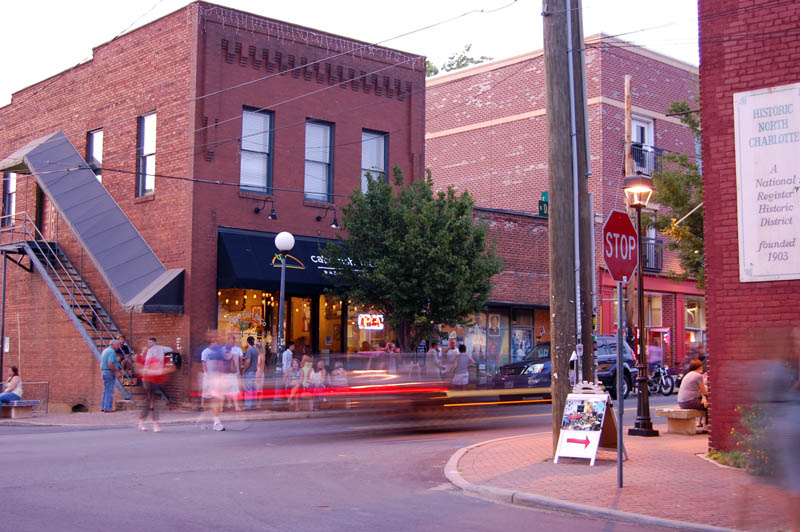
Photo Credit: James Willamor
Note: The following is an article submitted to us by a local restaurant worker. Have a story you’d like to submit to us? The Working People’s Press aims to be a voice for workers in Charlotte, and we encourage you to get involved and send in your own experiences to our email: WorkingPeopleCLT@proton.me
The landscape of food service work in Charlotte is abysmal and rife with worker’s rights violations, wage theft, and abuse. This isn’t news to anyone who’s ever worked in the industry, but it’s worth remembering that food service workers throughout the South have never had a period of greater organization and class consciousness.
Unlike large manufacturing, construction, or logistics industries that had the chance to adopt at least a union culture, if not full unionism, the food workers in a city like Charlotte have very little in the way of a road map to collective action. To add, certain calcified norms of the industry, as well as North Carolina’s viciously anti-worker, anti-union “right to work” laws, have presented barriers to organizing workers in any meaningful way.
I have worked in Charlotte area dining for the last decade and currently work at the very upscale, well-reviewed restauran. This is a far cry from the struggles that have been making waves in leftist circles like Waffle House (all power and support to Waffle House workers!) but in a way, it is Charlotte’s small restaurant group culture that insulates it further from reform or criticism.
For those that may not know, most mid-to upscale dining in Charlotte that isn’t part of a regional or national chain is controlled by small restaurant groups. These are organizations that usually control between 10 and 2 restaurants. Moffett, FS Food Group, 1957, Rare Roots Hospitality, Conte, and 5th Street are a few examples. Some are local, some are not; but they are inescapable when job hunting for kitchen and serving gigs in the city.
Just the few I listed have about 30 restaurants between them in Charlotte, and they only make up about half the notable food groups in the city. This isn’t odd – Most American cities are rife with food groups; but Charlotte’s dining scene seems to be particularly lousy with them, as it’s nearly impossible to work at a place that will offer a living wage, let alone any sort of rudimentary benefits without dealing with these companies who leverage their moderate to size to both disempower their workers and fly under the radar of NC’s anemic worker’s protections.
The kitchen I work in is pretty unique. It’s split into two floors inside of an old building. The top floor is exposed to the dining room and prominently features a 14-foot-long woodfire grill next to a large woodfire oven. In a normal working day, we will burn over 400 pounds of wood. This makes for a uniquely brutal and hot kitchen. Combined with the age of the building, this makes for constant maintenance issues and takes a physical toll on the grill workers.
As far as the workers are concerned, the grill operators deal with heat rash, muscle cramping, and dehydration every day, in addition to the normal line cook issues that come from working 10 to 12 hours on your feet with sharp objects and open fires. Many of the line cooks have passed out on the line or have come very close. I’ve had to be sent home after experiencing sudden dizziness, light headedness, tunnel vision, and trembling in my limbs. A few weeks later, another line cook I worked with ruptured a blood vessel in his leg while on the line and had to leave early to seek medical treatment. An infamous story from the first year of the restaurant, right before a much-needed overhaul of the air conditioning system, is of a line cook who had to quit working for the company after the heat from the grill damaged his stomach lining.
Despite this unique feature of the kitchen, line cooks are still expected to perform the way they would in any other kitchen: performing precision with dangerous equipment at high speed for several hours at a time. The key difference between my current restaurant and any other kitchen seems to be an agreement, not from management, but from any cook that actually works on line: “we all know that this is dangerous, and if you feel like you need to step off to not pass out, don’t hesitate, just go.”
As far as worker protections go, this represents a bare minimum, but it is one that management seems to support at the very least. In other similarly grueling kitchens I’ve been a part of, not even this much was guaranteed. In 2018, I worked at a country club in the summer in a partially outdoor kitchen, which got hot enough that one of my fellow line cooks had to be treated by EMS for heat stroke. The result was not a review of the conditions of the kitchen from management or the embrace of an unconditional break policy like my current employer, but instead to have a meeting with line cooks about the importance of hydration and knowing the signs of heat stroke.
A characteristic of most restaurants that makes them particularly tricky places to try to organize labor is their small-business status. It is a different thing for a relatively small group of people to successfully advocate for themselves, since there is always a waiting core of inexperienced workers for the boss to turn to quell any dissent and fill vacancies; especially in a so-called “right to work” state.
It’s not unheard of for staff to be almost entirely replaced after a “renovation” has closed a store for a month at the owner’s whim. This is an atmosphere perfect for the “small business tyrant” type of boss which many will recognize. A lack of size and importance ensures they have practically no supervision by the state or internal body, and a small staff will find it very hard to apply pressure due to job precarity; which means that the owner or boss can act unilaterally and with unchecked power to hire, fire, and change employment conditions.
The food group, however, amplifies these conditions by stringing together several small businesses with their own isolated work forces underneath one group of owner-investors, but with no business being so large that it would appear to require more oversight than any mom-and-pop restaurant. The owners accrue more capital and access to their entire workforce, while the workers at the individual restaurants usually never even meet.
If things are going to change for the working class in Charlotte, it’s going to require workers to raise their class consciousness. Holding solidarity with each other means when one person is fired, everyone else holds the line and doesn’t show up in solidarity. Start meeting, talking, and organizing for better conditions, better protections, and livable wages. Organizing teach-ins, talking about your rights as a worker, and collectively confronting management about working conditions are all small ways that workers can prove to each other their collective power over the capitalist exploiters that are Charlotte’s food groups.
 Working People's Press
Leave a comment