
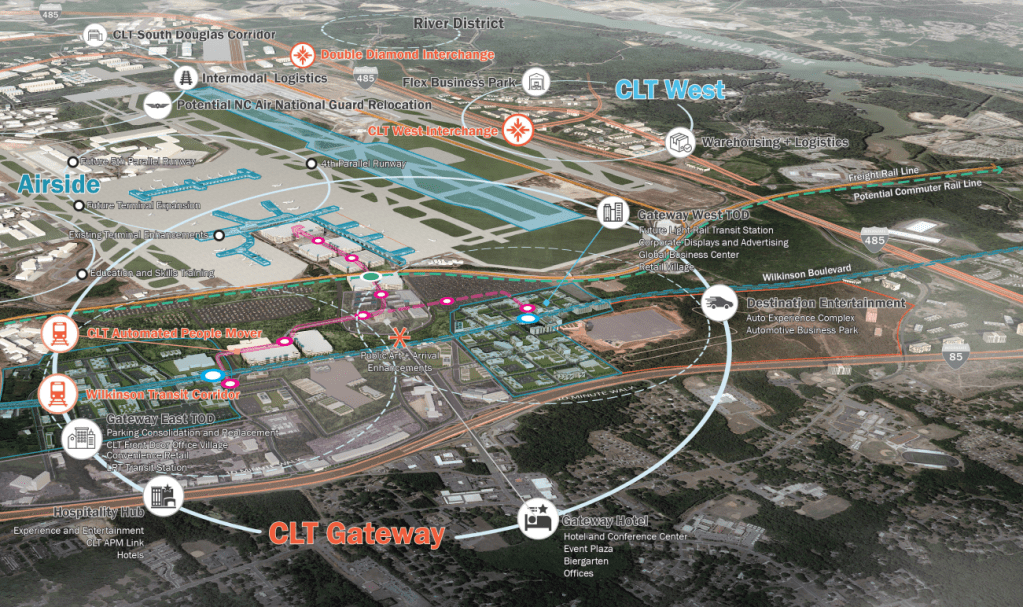
The Charlotte Douglas International Airport is planning to gobble up property all over Charlotte in the name of profit, all the while displacing historic, established, working-class, Black and brown families and neighborhoods.
The airport has already been a site of struggle for workers for the past few years. Last May cabin cleaners unionized and since have been struggling for better working conditions and wages. Flight attendants with American Airlines and Piedmont have also been calling for better wages for years.
The Charlotte Regional Business Alliance, in its marketing to reel in more corporations and investors, has highlighted Charlotte as a premier location for corporations to relocate, due to laughably weak labor protections in North Carolina. Due to being one of the five busiest airports in the world, the airport has been targeted by American Airlines, which earned billions in revenue last year, to become its central hub.
In 2017, the Charlotte Douglas International Airport published its commercial development strategy, which plans to completely revamp Charlotte’s current landscape into selected areas for hospitality, entertainment, retail, dining, offices, and manufacturing and logistics hubs. The plan has no mention of environmental impacts, investments into Charlotte’s schools, or anything about where all the workers who are supposed to staff its new complexes are supposed to live. Soon after this plan was published, an article from 2017 highlighted Gastonia as a “bedroom” community for the city.
Charlotte’s recently-implemented future land use plan shows the future of the neighborhoods surrounding the airport are in-line with this multi-million-dollar commercial development strategy. Though the UDO was championed as having been crafted with input from “multiple stakeholders,” it’s easy to see that the city of Charlotte’s interests are in lining the pockets of big business and the ruling class, instead of the working class whose labor allows the city to function. This is no surprise to workers of course, as Charlotte statistically has some of the worst wages and working conditions of any major city.
Charlotte’s neighborhoods will pay the price for this development. Steeleberry Acres, located to the South of the airport, has already faced the city’s business-first playbook. Residents of Steeleberry Acres, which is a middle-class neighborhood, organized to reject rezoning efforts from the city to no avail. Despite multiple meetings, phone calls, and canvassing efforts to bring city and airport officials to the table, the majority Democrat city government decided to de-designate a historic church to make way for its development of a major manufacturing and logistics facility.
In December, the city will hold a hearing to rezone a heavily wooded area with old-growth vegetation to build a major manufacturing and logistics warehouse that could possibly handle hazardous materials. At the same time, the airport is making pitiful offers to the homeowners in nearby neighborhoods, which do not match the current values of their homes.
The airport also plans to build a 5th parallel runway right over the top of a Black and Brown working-class housing complex, called the Stonewall Jackson Homes, toward the East of the airport, in Charlotte’s West side.
Millions of dollars will go to displacing working class people whose families have lived in Charlotte for generations just to line the pockets of the ruling class. Unsurprisingly, the areas of Southpark and Ballantyne where the majority of the city’s elite live, will remain untouched by the plan.
Over and over, the city’s ruling class has stayed true to its class interests. No amount of pleading to politicians will stop the mass displacement planned by the city, who claims it fights to curb gentrification and prioritize its historic communities. It will be up to workers and those sympathetic across the city to link up with the tenants and residents who are being squeezed out by the airport’s expansion. Only a unified mass eviction defense and collective struggle can put a halt to the city’s’ plans.
 Working People's Press
Leave a comment