
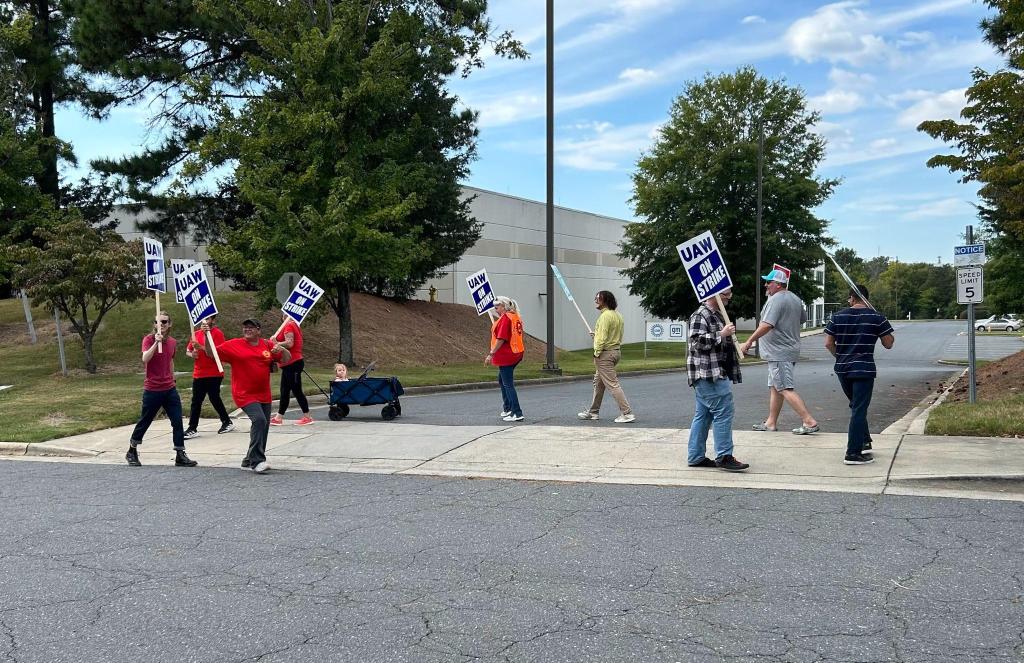
Autoworkers and supporters picket outside the GM Service Parts Distribution Center Friday afternoon.
At noon on Friday, more than one hundred autoworkers at Motors (GM) Service Parts Distribution Center in Charlotte, on Westinghouse Blvd, went on strike. They joined 37 other parts distribution centers that went on strike Friday as part of an expansion of the UAW’s strategy of selective striking.
After the initial walkout, which saw over a hundred workers, family members, and supporters rally outside the warehouse, a group of four to seven workers manned the picket line for the rest of the afternoon, waving signs and occasionally leading chants. Like those who began striking at three plants in the Midwest last week, Charlotte autoworkers are striking for wage increases, an end to the tier system, cost-of-living adjustments, and an end to plant closures and layoffs.
In recent years, General Motors has reported record profits, raking in over ten billion dollars a year. Despite this, the autoworkers from whom the company extracts its earnings haven’t seen a dime of it. “They pay us peanuts,” said one worker who reported that many of their coworkers have to work second jobs just to afford rent and basic living expenses. This is a common trend across America, with workers across the country seeing their purchasing power decreasing while their companies continue to rake in higher and higher profits.
The expansion of the UAW’s strike to now over forty facilities is a small step in the right direction, but if workers want to win the demands they deserve, an all-out strike is necessary. Even with Friday’s scaling up of the strike, still nearly ninety percent of UAW members at the Big Three automakers continue to go into work now in dangerous conditions under an expired contract. This has an impact on both the strikers and those who continue to work. Without a nationwide strike, those on strike are isolated, and production continues, weakening the bargaining power of strikers. Charlotte autoworkers were told yesterday that their warehouse would continue to receive shipments despite them being on strike, something which did not happen during the UAW’s nationwide General Motors strike in 2019. Meanwhile, the over 130,000 autoworkers still working end up actively working against the interests of those striking and themselves work under an expired contract which leaves them susceptible to being fired for petty reasons without protection.
This is no accident, Shawn Fain and the UAW’s leadership know this. The UAW’s leadership, just like the leadership of nearly every existing trade union in the United States, sell out the interests of their rank and file for that of the ruling class. The expansion of the strike shows this, as the facilities that went on strike Friday were parts distribution centers, which are aftermarket facilities at the last stop of the auto supply chain. It’s a positive development to see these centers go on strike, but they will have little effect on the production at General Motors and Stellantis. With the vast majority of UAW members at the Big Three still not on strike, particularly those at critical engine and transmission plants, the companies have seen minimal impact.
Many “leftists” have defended the UAW’s leadership, claiming the union would not be able to afford an all-out strike. The UAW has nearly a billion dollars in its strike fund, however, enough to support an all-out strike for months, and a supposed “lack of funds” has not stopped the UAW from donating tens of millions to politicians over the last decade. Autoworkers deserve to see all their demands met, and the only way to make this happen is through an all-out strike against the Big Three automakers. Union leadership has no plans of making this happen, meaning the rank and file of UAW, just like the rank and file of all trade unions, need to get organized to fight for their own interests.
 Working People's Press
Leave a comment